





Medically Reviewed by Lauren Wall, PA-C
One of the most common—and often misunderstood—injuries affecting the fingertips is mallet finger, sometimes called “baseball finger.” Despite the name, this condition isn’t limited to baseball players. It can happen to anyone who experiences a forceful blow to the tip of the finger, forcing it to bend further than it usually goes. As a result, you are unable to straighten the tip of your finger of thumb because of the injured tendon.
In this article, we’ll break down what mallet finger is, how it happens, what symptoms to watch for, and the treatment options available.
What Is Mallet Finger?
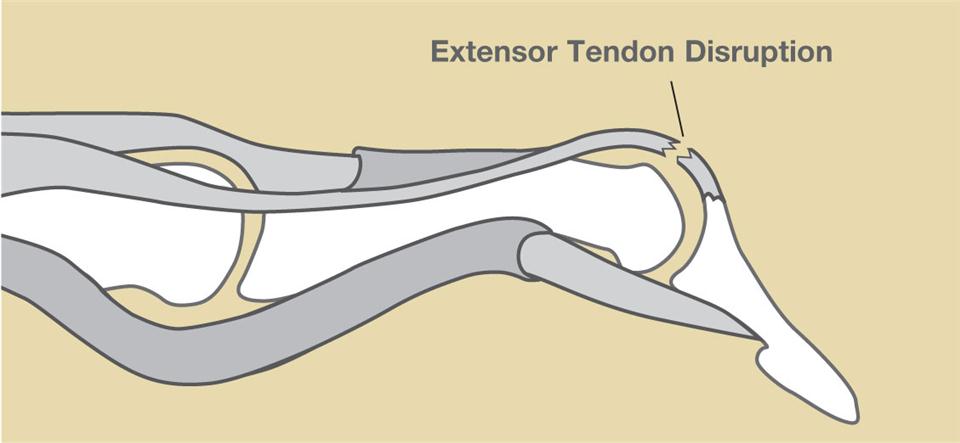
Mallet finger is an injury to the extensor tendon that straightens the last joint of the finger (the distal interphalangeal joint, or DIP). When this tendon is damaged or torn, the fingertip can no longer straighten on its own and droops downward.
This condition often occurs when an object—such as a ball—strikes the tip of an outstretched finger, forcibly bending it. The injury may involve:
- A rupture of the tendon
- A small bone fracture where the tendon attaches to the bone
While frequently associated with sports, particularly baseball and basketball, mallet finger can also occur during everyday activities such as:
- Jamming your finger while making a bed
- Catching your hand in a door
- Reaching into a drawer or cabinet
Anyone is susceptible, although athletes and active individuals are at higher risk.
Symptoms of Mallet Finger
The most recognizable symptom of mallet finger is the inability to fully extend the fingertip. Other signs include:
- A drooping fingertip that cannot be straightened voluntarily
- Swelling and tenderness at the top of the finger
- Redness or bruising at the site of impact
- Pain, especially when attempting to move the joint
In some cases, a small bone fragment may be pulled away with the tendon, known as a bony mallet finger.
Physician examination
To assess your fingertip injury, your physician will ask you for a complete medical history including what happened when you injured your finger, have you describe your symptoms, and conduct a physical examination. An X-ray may be necessary to determine the severity of the injury and determine a further course of treatment.
Treatment
In most cases, mallet finger is treated with splinting. A splint will hold the fingertip straight until it heals. Usually the splint must be worn for eight weeks, without removing it even for bathing. After the initial eight weeks, the splint is usually worn for three to four weeks on an occasional basis, perhaps during sleep.
Internal pinning or direct tendon repair can be performed when wearing a splint is not an option. Surgery may also be necessary if there is another injury in addition to the mallet finger or the joint is out of line. Surgery will include inserting pins to hold the pieces of bone together while the finger heals.
Rehabilitation
Recovery from mallet finger varies depending on the severity of the injury and how soon treatment begins. With proper care:
- Most patients regain normal finger function within a few months.
- Physical or occupational therapy may be recommended to restore strength and mobility.
- Delayed or improper treatment can result in a permanent droop or joint stiffness.
Schedule an Appointment with Raleigh Orthopaedic
If you’re dealing with pain, discomfort, or an injury, don’t wait to get the care you need. Our expert team at Raleigh Orthopaedic is here to help you feel better, move better, and get back to doing what you love. Schedule an appointment online or call us at 919-781-5600 to be seen—often within 48 hours. For immediate care, we offer walk-in orthopedic urgent care services. Click here for hours and locations.
Disclaimer: The information on this site is for general informational purposes only and is not intended as medical advice. It should not be used as a substitute for professional diagnosis, treatment, or medical judgment. Always consult a physician or qualified healthcare provider with any questions you may have about a medical condition or treatment.